303 vs 304 Stainless Steel: A Machining-Led Selection Guide
Two suppliers can review the same stainless steel drawing and recommend different materials. One may propose 303 to shorten turning cycles and stabilize chip control. Another may insist on 304 because the finished part will be welded, washed, exposed to condensation, or expected to retain a clean surface for years. Neither recommendation is automatically right. The correct decision depends on which risk dominates the part’s life.
That is the practical question behind 303 vs 304 stainless steel. These alloys belong to the same austenitic family and can look nearly identical on a material rack, yet a small chemistry change produces a significant manufacturing trade-off. Type 303 is designed to machine efficiently. Type 304 gives designers more freedom in corrosion exposure, welding, forming, and finishing.
This guide does not treat machinability ratings as a universal price calculator. Instead, it connects alloy chemistry to chip formation, tool wear, burrs, surface integrity, secondary processing, and the cost of each accepted part. It also defines when changing from 304 to 303 is a sensible value-engineering decision—and when that substitution creates more risk than it removes.
Difference Between 303 and 304 Stainless Steel: The Decision in One Table
The difference between 303 and 304 stainless steel is not simply that one is “easy” and the other is “difficult.” Each grade is optimized for a different manufacturing route. The table below provides a first decision screen before detailed cutting parameters or quotations are considered.
Decision factor
Type 303
Type 304
Engineering consequence
Primary advantage
Machining productivity
Corrosion and fabrication flexibility
Determines where value is created
Chip behavior
Generally shorter and easier to control
Longer, tougher, more likely to wrap
Affects automation and tool access
Work-hardening sensitivity
Present, but usually easier to manage
More sensitive to rubbing and dwell
Influences tool life and dimensional drift
Welding
Normally avoided for critical assemblies
Commonly welded with appropriate procedure
Controls assembly options
Cold forming
Limited compared with 304
Good ductility and formability
Matters for staking, bending, and formed features
General corrosion resistance
Suitable for many mild indoor environments
Better margin in moisture and routine washdown
Affects field reliability
Common product forms
Primarily round and hex bar
Bar, plate, sheet, tube, and wire
Changes blank strategy and material utilization
Typical use
Turned fittings, shafts, spacers, valve trim
Fabricated brackets, hygienic hardware, welded and formed parts
Links grade choice to process route
A useful sequence is to eliminate unsuitable grades before comparing cycle time. In a 303 vs 304 stainless steel review, welding, aggressive cleaning, continuous moisture, substantial cold forming, or a customer-controlled material specification usually favors 304. A bar-machined component in a mild environment deserves a serious 303 evaluation. A lower quotation is not a saving if it creates finishing, validation, or field-replacement costs; specifying 304 by habit can likewise add avoidable machine hours to a dry-service turned part.
For a broader view of available grades, processes, and finishing options, see our stainless steel CNC machining capabilities.
Why Sulfur Changes 303 Stainless Steel Machinability and Corrosion Resistance
Type 303 stainless steel is often described as the free-machining version of 304. That description is useful, but the reason matters. Manufacturers intentionally increase sulfur so that manganese sulfide inclusions form throughout the metal. During cutting, these inclusions help interrupt the continuous deformation of the chip. The material is more willing to produce manageable chip segments instead of a long ribbon that wraps around the tool or scratches the finished surface.
This is why the phrase free machining stainless steel refers to chip behavior and cutting response, not to a soft or weak metal. Type 303 is still an austenitic stainless steel. It still generates heat, requires a rigid setup, and can work-harden if a dull edge rubs rather than cuts. Its advantage is that the cutting zone is easier to manage, especially in repeated turning, grooving, drilling, and threading operations.
The same inclusions create the principal trade-off. A chromium-rich passive film protects stainless steel, but manganese sulfide inclusions can interrupt the uniformity of that surface. In moisture containing salts or aggressive cleaning residues, localized attack may begin around an inclusion. The result is usually a higher susceptibility to pitting rather than uniform corrosion across the whole component.
This mechanism explains why a polished 303 part can look excellent at shipment yet still offer less environmental margin than a comparable 304 stainless steel part. Surface appearance cannot resolve 303 vs 304 stainless steel. Passivation can remove embedded free iron and support a clean passive state, but it cannot remove internal sulfide inclusions or convert the base alloy into 304.
Sulfur also reduces transverse ductility and makes severe cold working less attractive. During welding, sulfur-rich regions increase hot-cracking risk as the weld pool solidifies. Atlas Steels describes the same two-sided effect: sulfur-bearing inclusions improve chip breaking and reduce built-up edge while reducing pitting resistance, ductility, and weldability. Type 303 is not simply inferior; it is optimized for a narrower job.
303 vs 304 Machinability in Turning, Drilling, Threading and Milling
The most visible distinction in 303 vs 304 machinability is the chip, but chip shape also affects heat removal, surface scratching, unattended operation, and operator intervention. Across thousands of parts, those effects make 303 vs 304 stainless steel a production-economics decision rather than a laboratory comparison.
The strong 303 stainless steel machinability advantage appears most clearly in bar-fed turning. Shorter chips are less likely to wrap around a small shaft, collect behind a shoulder, or interfere with a cutoff tool. A stable chip also helps a Swiss-type lathe repeat a cycle without frequent manual clearing. Thread profiles, grooves, flats, and cross-holes can therefore be combined in one automated sequence with lower disruption risk.
By comparison, 304 stainless steel machinability depends heavily on keeping the tool in a true cutting condition. Type 304 is tough and has low thermal conductivity, so heat remains concentrated near the cutting edge. If the feed becomes too light, the edge loses sharpness, or the tool dwells at the bottom of a hole, the surface can harden. The next cutting edge must then penetrate material that is harder than the original stock.
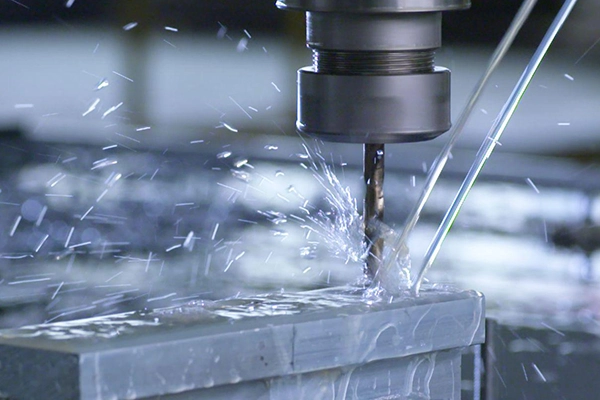
That behavior is the practical meaning of stainless steel work hardening. The solution is not automatically to reduce the feed. A timid cut may increase rubbing, create more heat, and harden the surface further. Successful 304 machining instead depends on a rigid machine, short tool overhang, sharp geometry, sufficient chip load, controlled engagement, and coolant delivery that reaches the cutting zone.
Operation
Typical 303 behavior
Typical 304 behavior
Practical process response
Turning
Chips break more readily; stable for bar work
Long chips can wrap around shoulders and tools
Select an effective chipbreaker and maintain a positive feed
Small-hole drilling
Chip evacuation is generally more forgiving
Rubbing and packed chips can harden the hole wall
Use sharp drills, controlled pecking, and direct coolant where possible
Internal threading
Lower cutting load and cleaner chip control
Heat, burrs, and chip evacuation become more critical
Avoid repeated rubbing passes and monitor tool condition
Pocket milling
Predictable cutting when engagement is stable
Re-entry into a hardened skin can damage the edge
Use a continuous toolpath and avoid dwelling in corners
Grooving and parting
Shorter chips reduce interference
Narrow tools carry concentrated heat and side pressure
Maximize rigidity and keep coolant at the tip
Thin-wall finishing
Lower cutting force can simplify control
Heat and clamping can combine to distort the wall
Use broad soft jaws, staged roughing, and a controlled finish pass
Turning. Type 303 is attractive for concentric diameters, grooves, external threads, and cutoff operations. Its gain comes from both cutting speed and fewer chip interruptions. Type 304 can produce excellent turned components, but insert condition needs tighter control.
Drilling. Small drills magnify the difference because heat and chips have little escape space. In 304, pausing or recutting packed chips can harden the bore wall and destabilize later reaming or tapping. The more breakable 303 chip reduces this escalation, although deep holes still need effective coolant and evacuation.
Threading. Internal threads combine high contact pressure with restricted chip space. Type 303 commonly gives high-volume fittings a more stable cycle. Type 304 needs closer control of tap geometry, thread milling, entry chamfers, coolant, and cross-hole burrs. A thread can pass a gauge while retaining a torn crest or internal burr.
Milling. The difference is less dramatic in broad interrupted cuts than in continuous turning, but repeated entry into a rubbed 304 surface still accelerates wear. Toolpaths should maintain engagement and keep the finishing edge out of a work-hardened roughing layer.
Published ratings guide 303 vs 304 stainless steel process planning; they do not generate a quotation. SSINA notes that 303 may run approximately 25–30 percent faster under suitable conditions, but probing, handling, inspection, and speed-limited features can dominate a real cycle.
Our precision CNC machining services combine turning, milling, drilling, threading, deburring, and inspection around the requirements of the actual part rather than a generic material rating.
303 vs 304 Corrosion Resistance, Weldability and Surface Finishing
A meaningful 303 vs 304 corrosion resistance comparison must begin with the service environment. “Indoor” is not precise enough: a dry control-cabinet component faces a different exposure from a fitting near coolant, condensation, or chloride-bearing cleaners.
Type 303 can perform well in mild environments. Risk rises when moisture persists, deposits create crevices, cleaner remains in a blind hole, or salt collects at a thread root. In 303 vs 304 stainless steel, narrow gaps and cross-hole intersections can matter more than an open polished face because they retain liquid and restrict oxygen replenishment.
Type 304 provides a better general corrosion margin because it does not rely on the elevated sulfur level used to improve 303 machining. However, 304 is not a universal marine alloy. If a component sees seawater, de-icing salts, or strong chloride process media, the real comparison may need to move beyond both grades to 316 or another more resistant alloy.
Welding creates a clearer boundary. 303 stainless steel weldability is poor for critical production because sulfur that helps machining also raises hot-cracking risk. A successful-looking trial weld does not establish a robust production process. If a part will be welded to a tube, bracket, boss, or frame, 304 is normally the more defensible starting point.
By contrast, 304 stainless steel weldability supports a much wider range of fabricated assemblies. Welding procedure, filler choice, heat input, distortion, and post-weld cleaning still matter, but the alloy is intended for this type of fabrication. For welded work where sensitization is a concern, the low-carbon 304L variant may be specified instead of standard 304.
Finishing must also be understood correctly:
Mechanical polishing changes texture and appearance but does not change the alloy chemistry.
Bead blasting can create a uniform matte surface, but media cleanliness is essential to avoid embedding carbon-steel contamination.
Passivation removes free iron and promotes a clean passive condition; it does not erase sulfide inclusions.
Electropolishing smooths microscopic peaks and can improve cleanability, but it does not make 303 equivalent to 304 in a corrosive service environment.
For threads, valve seats, small bores, and seals, a cosmetic finish can hide machining marks without addressing burrs, embedded iron, or trapped residue. Finishing should follow the required function—appearance, cleanability, corrosion control, or sealing—not a generic request for brightness.
The 304 stainless steel machining guide explains how cutting strategy, heat control, and finishing interact when corrosion and fabrication flexibility take priority.
303 vs 304 Stainless Steel Cost and Application Decisions
The useful 303 vs 304 stainless steel cost comparison is not the purchase price per kilogram. Buyers pay for conforming parts delivered on time, and the material influences nearly every term in that calculation:
Delivered cost per accepted part = material + machine time + tooling + handling + deburring + finishing + inspection + scrap risk + service-risk allowance
Consider a hypothetical sensor fitting produced from hex bar. It has an external thread, an internal thread, a small axial bore, a cross-hole, and two sealing diameters. This is not presented as customer production data; it is a transparent model showing how quantity changes the decision.
Cost driver
100 pieces
1,000 pieces
10,000 pieces
Programming and setup
High cost per part
Spread across the batch
Small unit contribution
Raw material
Visible but not dominant
Important
Important
Cutting cycle
Moderate influence
Major influence
Critical influence
Insert and drill life
Limited number of changes
Recurring cost
Major tooling and downtime cost
Chip clearing
Manageable interruption
Production disruption
Automation constraint
Deburring
Important at cross-holes
Significant labor
Requires process automation or redesign
Finishing
Batch-dependent
Stable secondary cost
Must be tightly controlled
Field corrosion exposure
Same functional risk
More units exposed
Large potential warranty impact
At 100 pieces, setup and inspection may mask much of 303’s cycle advantage. At 1,000 pieces, chip stability and tool life become visible. At 10,000 pieces, small differences in cycle time or insert life justify a detailed 303 vs 304 stainless steel review—but quantity also multiplies the consequence of a wrong environmental choice.
This produces a better decision rule for 303 vs 304 stainless steel: use 303 when machining time genuinely dominates the delivered cost and the service conditions accept its limitations. Use 304 when welding, forming, moisture, cleaning, or customer requirements make environmental and process flexibility more valuable than spindle efficiency.
Part or service condition
Preferred direction
Reason
High-volume turned shafts
303
Chip control and cycle efficiency
Threaded spacers and bushings
303
Most value is created by machining from bar
Indoor adjustment hardware
303
Mild environment and no welding
Welded brackets or bosses
304
Welding compatibility is decisive
Washdown equipment components
304
Better corrosion margin and finish flexibility
Formed clips and retainers
304
Better ductility for forming operations
Exposed automotive sensor mounts
304 or a higher grade after review
Moisture, road residue, and cleaning exposure
Saltwater components
Usually neither 303 nor standard 304
Evaluate 316/316L or another appropriate alloy
Automotive applications show why “indoor” and “outdoor” are insufficient labels. A cabin adjustment part may remain dry and favor high-volume turning; an under-hood fitting sees heat cycles and condensation; an underbody part may encounter road salt. One industry can therefore justify different grades by location.
Our automotive CNC machining parts page shows how material, tolerance, surface treatment, and production volume are evaluated together for vehicle components.
Before approving a substitution, use four gates:
Does the part require welding, brazing, substantial forming, staking, or swaging?
Will it experience persistent moisture, washdown, salt, chemicals, or fluid trapped in crevices?
Is machining time a major share of the delivered cost at the expected volume?
Do the drawing, customer specification, regulatory requirement, or validation record permit the grade change?
If any of the first, second, or fourth gates rejects 303, a faster cutting cycle is irrelevant. If those gates are clear, production trials can compare real cycle time, insert consumption, burr condition, dimensional capability, and finishing response. That evidence is more useful than selecting a grade from a generic percentage alone.
Frequently Asked Questions About 303 vs 304 Stainless Steel
Is 303 stainless steel stronger than 304 stainless steel?
Not in a way that supports a universal answer. Published mechanical properties depend on product form, diameter, specification, annealed or cold-worked condition, and the actual material lot. The two grades can have broadly similar room-temperature properties, but strength should be checked against the governing material certificate and design requirement. The usual reason to select 303 is machinability, not a guaranteed strength advantage.
Can 303 stainless steel replace 304 stainless steel?
Sometimes, but never automatically. Substitution may be reasonable for a bar-machined component in a mild environment when no welding or severe forming is required and the customer permits the change. It is usually inappropriate when the original 304 requirement protects corrosion performance, fabrication, hygiene, or an existing validation record. Visual similarity is not evidence of equivalence.
Does passivation make 303 as corrosion resistant as 304?
No. Passivation is valuable because machining can embed small amounts of free iron that later appear as rust staining. Removing that contamination helps both alloys establish a clean passive surface. It does not remove manganese sulfide inclusions from 303 or reproduce the base-metal corrosion behavior of 304.
Which grade is better for high-volume CNC turning?
For a non-welded component in a mild environment, 303 is often the stronger production candidate because its chip control can support shorter cycles, fewer interruptions, and more predictable tool use. The answer changes if corrosion exposure, forming, finishing, or customer specifications dominate. The question is not merely 303 or 304 stainless steel for CNC machining; it is which grade produces the lowest-risk accepted part.
The final recommendation for 303 vs 304 stainless steel is therefore conditional rather than absolute. Choose 303 when the part is made primarily from bar, volume makes machine time important, the environment is mild, and no welding or severe forming follows. Choose 304 when the component needs fabrication flexibility, routine washdown resistance, better general corrosion margin, or broader product-form availability.
Most importantly, do not replace a specified grade simply because another alloy cuts faster. Confirm what the original material requirement protects, then validate any proposed change against service exposure, downstream processing, dimensional capability, finish, and customer approval. That approach captures the real machining value of 303 without transferring hidden risk into the finished product.
Ready to start
Your next project?
Contact our technical experts today for a customized solution and a tailored quotation.
Our expert team will contact you within 24 hours
to provide a free technical evaluation and solution design, helping you upgrade your production process.
ADDRESS
NO.22,You Yi Road ,Wulian Community, LongCheng Street ,Long gang District ,Shen Zhen