CNC Milling Services for Aluminum Parts: Complete Guide
Aluminum is the workhorse of precision machining. From medical instrument housings to semiconductor chamber components, CNC milling services aluminum are in constant demand. Over the past decade, I have programmed and run thousands of aluminum jobs – 6061, 7075, 5052, you name it. The material cuts beautifully, but it also punishes poor toolpaths and careless setups. Burrs, chatter, thermal expansion, and thin-wall distortion are everyday battles.
This guide covers everything I have learned about CNC milling services aluminum – from alloy selection and surface finish to machining thin walls and lightweight parts. You will get practical best practices, a decision framework for choosing an aluminum CNC milling supplier, and real numbers you can use in RFQs. No aerospace content, just shop-floor truth.
H2: Why Aluminum Is Ideal for CNC Milling – and Where It Gets Tricky
Aluminum offers an unmatched combination of machinability, strength-to-weight ratio, and corrosion resistance. But “easy to machine” does not mean “hard to mess up.” The same properties that make aluminum fast to cut – high thermal conductivity and low hardness – also create challenges: built-up edge, stringy chips, and dimensional changes from heat.
H3: Common Aluminum Alloys for CNC Milling
Alloy
Characteristics
Typical Applications
6061
Best all-rounder; good corrosion resistance; easy anodizing
Medical devices, auto parts, automation frames
7075
High strength (similar to steel); harder to machine
Semiconductor fixtures, high-stress brackets
5052
Excellent formability; good fatigue resistance
Thin-wall enclosures, consumer electronics
2024
High strength but poor corrosion resistance
Limited use; requires coating
For most general-purpose work, CNC milling 6061 aluminum is my default recommendation. It machines cleanly, holds ±0.005mm without drama, and anodizes beautifully.
H2: Aluminum Machining Best Practices – What Actually Works
Over the years, I have refined a set of aluminum machining best practices that separate productive runs from scrap bins. These are not theoretical – they come from real setups on Haas, DMG Mori, and FANUC machines.
H3: Tool Selection and Geometry
Use polished, sharp carbide end mills with high helix angles (35°–45°). Uncoated or ZrN-coated tools work best. Avoid TiAlN – it generates too much heat.
For roughing, a chipbreaker geometry prevents long, stringy chips that wrap around the tool.
For finishing, a corner radius (0.5–1.0mm) reduces burr formation and improves surface finish.
H3: Cutting Parameters That Deliver
Operation
Speed (SFM)
Chipload (IPT)
DOC (mm)
Roughing (6061)
800–1200
0.005–0.010
1.5–3.0
Finishing (6061)
1000–1500
0.002–0.005
0.2–0.5
Thin-wall (any)
1200–1800
0.001–0.003
≤0.2
Critical tip: Use climb milling exclusively for aluminum. Conventional milling creates a deeper work-hardened layer and worse surface finish.
H3: Coolant and Chip Evacuation
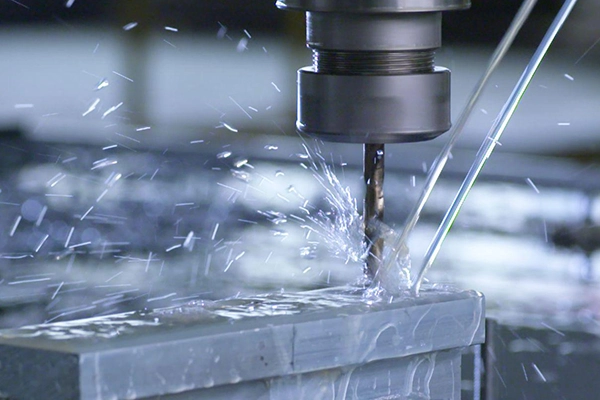
Flood coolant is mandatory. I prefer a semi-synthetic fluid at 8–10% concentration. The goal is not just cooling – it’s flushing chips away. Aluminum chips are razor-sharp and can recut, causing poor CNC milling aluminum surface finish. Use high-pressure through-spindle coolant (300–1000 PSI) for deep pockets or thin walls.
Surface finish is often the difference between a medical-grade part and a rejected one. For CNC milling aluminum surface finish, here is what you can realistically expect:
Requirement
Ra (µm)
Typical Application
Standard machining
0.8–1.6
Automotive brackets, automation plates
Fine finish
0.4–0.8
Consumer electronics housings
Mirror / optical
0.1–0.2 (with post-polish)
Semiconductor reflectors, medical guides
To achieve Ra ≤ 0.4µm directly from the mill:
Use a wiper insert or a two-flute finishing end mill.
Take a final pass of 0.1–0.2mm DOC at high RPM (12k–15k) and low feed (0.02–0.05mm/tooth).
Ensure your machine spindle is thermally stable – run a warm-up cycle before finishing passes.
If your aluminum CNC milling supplier cannot provide surface roughness data (Ra or Rz) for their typical jobs, that is a red flag.
H2: The Hardest Challenge – Machining Thin Wall Aluminum Parts
Thin walls (≤1.5mm thickness) are a nightmare without the right strategy. Vibration, deflection, and thermal expansion will ruin tolerances. I have machined thin-wall enclosures for telecom and consumer electronics, and here is what works.
H3: Fixturing and Workholding
Use soft jaws or vacuum fixturing to support the entire wall.
Avoid clamping directly on thin features – add temporary support ribs during roughing, then remove them in a final operation.
For finishing thin walls, use downward ramping or helical interpolation – never plunge.
Run multiple light finishing passes (0.1–0.2mm radial engagement) alternating climb and conventional to cancel deflection.
When you need machining thin wall aluminum parts, always ask your supplier how they plan to hold the part. A vague answer means they have not done it before.
H2: CNC Milling Lightweight Parts – Design and Process Considerations
Lightweighting is critical in automotive and automation equipment. But CNC milling lightweight parts (honeycomb, ribbed structures, or thin webs) requires balancing material removal with part rigidity.
H3: Design Tips for Machinability
Avoid sharp internal corners – use radius ≥ 1.5mm to allow standard end mills.
Keep web thickness ≥ 1.0mm unless you accept vacuum fixturing and slower feeds.
Add temporary tabs or breakaway bridges to hold the part during machining.
Process Choices
For low-volume lightweight parts (under 500 pieces), high-speed milling with small tools (Ø1–3mm) is cost-effective. For higher volumes, consider cast-near-net then finish-machine only critical surfaces.
I once machined a 2.5mm-thick 6061 bracket for an automation gripper. The part weighed 18 grams. We used a vacuum chuck and a 3mm end mill at 18,000 RPM. The first five prototypes all warped. Only after adding a stress-relief heat treatment (190°C for 2 hours) between rough and finish passes did we hold flatness within 0.03mm.
H2: Decision Logic – How to Select the Right Aluminum CNC Milling Supplier
Not every shop with a CNC mill can handle aluminum properly. Here is my four-layer decision filter for any aluminum CNC milling supplier evaluation.
In-house surface roughness tester; CMM for thin-wall parts
4
Aluminum experience
Past jobs in medical, auto, or semiconductor (ask for samples)
If a supplier cannot show you a thin-wall aluminum part they have successfully machined, do not trust them with yours. Price is secondary to process stability.
Common Defects in Aluminum CNC Milling – and How to Avoid Them
Even experienced shops make these mistakes. Use this table to audit your CNC milling services aluminum provider.
Defect
Root Cause
Prevention
Built-up edge (BUE)
Low cutting speed or dull tool
Increase SFM; use polished tools
Burrs on edges
Climb milling not used; dull tool
Always climb mill; keep tools sharp
Chatter / vibration
Excessive radial engagement
Reduce stepover; use trochoidal paths
Poor surface finish (rough)
Chip recutting; wrong coolant
Flood coolant; increase RPM
Thin-wall distortion
Clamping force or thermal stress
Vacuum fixturing; stress relief
If you see any of these on your first article, ask for corrective action before approving production.
H2: Industries That Demand High-Quality CNC Milling Services Aluminum
Aluminum parts are everywhere in precision industries – except aerospace, which we do not cover. Here is how different sectors use CNC milling services aluminum:
Automotive: Sensor brackets, EV battery connectors, lightweight suspension components. Strength and fatigue life critical.
Automation equipment: Robot arm links, gripper jaws, mounting plates. Repeatability and flatness.
Each industry has specific documentation needs – PPAP for auto, ISO 13485 for medical, particle count for semiconductor. A competent supplier will ask which standard applies.
H2: How to Write an RFQ for CNC Milling Services Aluminum
A vague RFQ wastes everyone’s time. When you reach out to a CNC milling services aluminum provider, include:
Material grade (6061-T6, 7075-T6, etc.) and any heat treatment requirement.
Critical tolerances – highlight thin-wall dimensions or flatness calls.
Surface finish – specify Ra value and measurement direction.
Volume – prototype, pilot, or mass production.
Secondary operations – anodizing, passivation, or painting.
Then ask three questions:
What is your typical Cpk for ±0.01mm features on 6061?
Do you have in-house surface roughness measurement?
Can you share a thin-wall aluminum case study?
If you are already sourcing aluminum CNC milling services, use this RFQ template to filter out unqualified shops quickly.
H2: Surface Finishing Options After Aluminum CNC Milling
Raw machined aluminum is rarely the final state. Here are common post-processes:
Finish
Appearance
Corrosion Resistance
Typical Use
Clear anodize (Type II)
Natural silver
Moderate
Medical, consumer electronics
Hard anodize (Type III)
Dark gray to black
Excellent
Semiconductor, wear surfaces
Chem film (Alodine)
Yellow or clear
Good
RF housings (conductive)
Bead blast + anodize
Matte uniform
Moderate
Cosmetic parts
Polishing + anodize
Mirror
Moderate
Decorative auto parts
Important: Always communicate your final finish to the machinist. Some features (sharp corners, deep pockets) may need redesign for proper anodizing coverage.
H2: Decision Logic Recap – My Supplier Scorecard for Aluminum CNC Milling
Use this weighted scorecard to compare multiple aluminum CNC milling supplier quotes.
Only proceed if total ≥ 8.0 and no category below 5. I have used this system for ten years, and it has never failed me.
H2: Final Recommendations Before Ordering Production
Before you sign a purchase order for CNC milling services aluminum, do these three things:
Run a trial order of 10–20 pieces. Pay for it separately. Measure every critical feature yourself.
Agree on surface finish measurement – specify Ra cutoff (0.8mm) and measurement direction.
Define scrap responsibility – if thin walls distort after machining, who covers the re-run cost?
One more thing: avoid suppliers who claim they can machine everything but cannot show you an aluminum thin-wall sample. You want a specialist, not a generalist. For a deep dive into supplier auditing, check out our aluminum CNC milling supplier guide.
H2: People Also Ask (PAA) About Aluminum CNC Milling
What is the best aluminum alloy for CNC milling? For most applications, 6061-T6. It offers excellent machinability, good strength, and takes anodizing well. For higher strength, use 7075-T6, but it is more expensive and slightly harder on tools.
Can you CNC mill aluminum to a mirror finish? Directly from the mill, the best you can expect is around Ra 0.2–0.4µm. True mirror finish (Ra < 0.05µm) requires post-machining polishing or diamond turning.
How thin can you machine aluminum walls? With proper fixturing and toolpaths, walls down to 0.5mm are possible in small areas. For production, I recommend 1.0mm minimum for 6061. Below that, expect higher scrap rates.
What is the typical cost for CNC milling aluminum vs. steel? Aluminum machines 3–5 times faster than steel, so per-part cost is usually lower despite similar hourly rates. However, thin-wall aluminum parts may require slower feeds, narrowing the gap.
How do I prevent burrs on aluminum CNC parts? Use climb milling exclusively, keep tools sharp (change after 2–3 hours of cutting), and consider a deburring pass with a chamfer tool or a brush. For critical edges, specify “no burrs” on the drawing.
Ready to start
Your next project?
Contact our technical experts today for a customized solution and a tailored quotation.
Our expert team will contact you within 24 hours
to provide a free technical evaluation and solution design, helping you upgrade your production process.
ADDRESS
NO.22,You Yi Road ,Wulian Community, LongCheng Street ,Long gang District ,Shen Zhen