Difference Between 6061 and 6063 Aluminum: A CNC Machinist’s Perspective on Strength, Finish, and Real-World Performance
Walk onto any shop floor and ask a machinist whether they’d rather run 6061 or 6063 aluminum, and you’ll get an answer within seconds. But ask an engineer which one belongs on their BOM, and the conversation gets longer. The difference between 6061 and 6063 aluminum isn’t just a number on a data sheet—it’s the difference between a part that holds up under load and a part that looks like a million bucks straight off the machine.
Both alloys sit in the 6000 series, both use magnesium and silicon as their primary hardening elements, and both machine beautifully. But the difference between 6061 and 6063 aluminum comes down to one fundamental trade-off: strength versus surface quality.
Here’s what that means for your next CNC machining project—whether you’re building LED frames, consumer electronics enclosures, telecom chassis, automotive brackets, or automation equipment.
The Core Difference Between 6061 and 6063 Aluminum – Chemistry and Composition
The core difference between 6061 and 6063 aluminum is in the chemistry. 6061 carries more magnesium (0.8–1.2% vs. 0.45–0.9%), more silicon (0.4–0.8% vs. 0.2–0.6%), and a small but meaningful amount of copper (0.15–0.4%) that 6063 doesn’t have. 6061 also contains up to twice the iron content of 6063. Those extra alloying elements translate directly into higher strength and hardness—but they also make 6061 slightly less forgiving in the extrusion die and slightly less brilliant after anodizing.
6063, by contrast, is leaner. Lower alloy content means it flows through extrusion dies more easily, takes on complex cross-sections without cracking, and produces a surface that anodizes to a bright, uniform finish that makes consumer electronics designers happy.
Think of 6061 as the structural workhorse and 6063 as the surface specialist.
6061 vs 6063 Aluminum Strength – Mechanical Properties Side-by-Side
Let’s cut through the marketing and look at the actual numbers. The 6061 vs 6063 aluminum strength comparison starts with yield and tensile values. These are typical for the T6 temper—the most common heat-treated condition.
Property
6061-T6
6063-T6
What It Means for Your Part
Tensile Strength (MPa)
~310
~241
6061 can handle about 30% more load before failure
Yield Strength (MPa)
~276
~214
6061 resists permanent deformation at significantly higher stress
Elongation at Break (%)
~12
~12
Both offer similar ductility—neither is brittle
Brinell Hardness (HB)
~95
~73
6061 is noticeably harder; it resists wear and galling better
Elastic Modulus (GPa)
~68.9
~68.9
Stiffness is identical—deflection under load is the same
When comparing 6061 vs 6063 aluminum strength, 6061 is the clear winner for load-bearing applications. But strength isn’t everything—you also need to consider how the alloy behaves under compression and what stress limits your design code allows.
CNC Machining Behavior – Which Alloy Runs Smoother on the Mill?
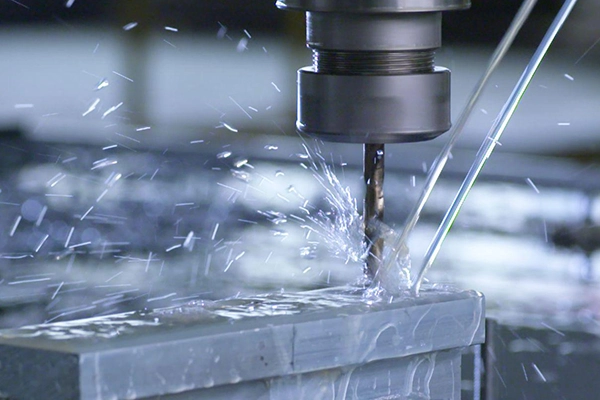
This outlines key differences between 6061 and 6063 aluminum for CNC machining. Harder 6061 creates clean broken chips, avoids tool gumming, delivers smooth raw finishes and stable ±0.005 mm tight tolerances with reliable feeds/speeds, ideal for thin walls and precision parts. Softer, gumminer 6063 yields tangled stringy chips needing careful CAM tuning; it shines for cosmetic high-speed finishing but demands stricter control over cutting parameters. Visit our CNC machining page to check our standard equipment and tolerance capabilities for alloy selection.
Machining Characteristic
6061 Aluminum
6063 Aluminum
Chip Formation
Clean, broken chips
Stringy, continuous chips
Tool Wear
Moderate—predictable
Lower cutting resistance, minimal wear
As-Machined Surface Finish
Good out of the gate
Requires tuned parameters for best results
Thin-Wall Machining
More stable—less flex
Softer—can deflect or burr
Dimensional Stability
Excellent—half the deformation of 6063 under cutting stress
Good—but more prone to deflection
Aluminum 5052 vs 6061 – When to Consider the Other Alloy
Not every project calls for 6000-series. Sometimes the difference between 5052 and 6061 aluminum matters more than the 6061/6063 debate. 5052 is a non-heat-treatable alloy with magnesium as its primary addition. It offers superior formability, excellent corrosion resistance (especially in marine environments), and a lower strength profile—yield around 193 MPa in the H32 temper.
So where does 5052 beat 6061? In sheet metal fabrication, deep drawing, and bending operations. 5052 can be bent to tight radii without cracking, while 6061 often requires larger bend radii or annealing. For LED frames that involve complex sheet-metal enclosures, 5052 is a common choice. For machined components, however, 6061 is far more common because it machines cleaner and responds to heat treatment.
The aluminum 5052 vs 6061 decision often comes down to manufacturing process: stamping and forming → 5052; CNC machining from bar/plate → 6061. 6063 sits in the middle—it forms better than 6061 but not as well as 5052, and it machines better than 5052 but not as cleanly as 6061.
For a deeper dive into 5052’s properties, check our aluminum CNC machining material guide.
How to Choose Between 6061, 6063, and 5052 – A Practical Decision Framework
Here’s the decision process I walk through with every client who asks about the difference between 6061 and 6063 aluminum—or when 5052 enters the conversation.
Step 1 – Does the part carry structural load or see cyclic stress?
Yes → 6061 (highest strength and fatigue resistance)
No → consider 6063 or 5052
Step 2 – Is the part extruded or machined?
Extruded with complex profile → 6063 is easiest
Machined from solid stock → 6061 gives best chip control
Stamped/bent from sheet → 5052 wins
Step 3 – Is anodized appearance critical?
Yes → 6063 gives a superior, more uniform finish
No → 6061 or 5052 are fine (5052 anodizes reasonably well but not as bright as 6063)
Step 4 – What’s your tolerance requirement?
Tight (±0.005 mm or better) → 6061 holds dimensions most repeatably
Moderate → any alloy works
Step 5 – What’s your cost and availability?
6063 is typically slightly less expensive for extruded profiles
6061 is the most widely stocked and often the cheapest for bar/plate
5052 is common in sheet form but less so in bar
For most automotive CNC machining parts, 6061 dominates structural and safety-critical components. For consumer electronics exteriors, 6063 often wins for visible enclosures, while 6061 takes the internal structural frames. For telecom and automation, it’s a mix—6061 for brackets and mounting plates, 6063 for cosmetic front panels, and 5052 for bent sheet-metal enclosures.
If you need to reference the hardness data for 6061, our hardness of 6061 aluminum guide provides detailed Brinell and Rockwell values.
Real-World Applications Across Industries – Where Each Alloy Belongs
LED frames – Large structural frames that support heavy arrays: 6061 for strength; decorative trim or heat-sink fins: 6063 for extrudability.
Consumer electronics – Smartphone unibodies, laptop lids: 6063 for anodized finish; internal mid-frames and brackets: 6061.
Telecom enclosures – Outdoor cabinets needing rigidity: 6061; rack-mount front panels and cosmetic covers: 6063.
Automotive parts – Suspension mounts, engine cradles, structural reinforcements: 6061; interior trim and decorative brightwork: 6063.
Automation equipment – Robotic arm bases, machine guarding: 6061; conveyor covers and sensor housings: 6063 or 5052 for formed sheet.
The Two Search Variations – Aluminum 6061 vs 6063 and 6063 Aluminum vs 6061
Whether you type aluminum 6061 vs 6063 or flip it to 6063 aluminum vs 6061, the underlying material properties don’t change—but the way people search does. Some engineers use the “aluminum” prefix, others put it at the end. In practice, both search terms point to the same question: which alloy should I choose? The answer remains the same—it’s all about your application’s balance of strength, machinability, and surface finish.
What I’ve Learned Running Thousands of Aluminum Parts
I’ve machined more aluminum than I can count across mills and lathes. Here’s the shop-floor truth:
6061 is the default for a reason—it’s forgiving, predictable, and strong enough for 90% of structural work.
6063 is what you spec when you know you need a beautiful anodized finish or a complex extrusion that 6061 can’t handle.
5052 is your go-to when you’re bending sheet metal into complex shapes and don’t need high strength.
The biggest mistake? Engineers spec 6061 for cosmetic parts because “it’s stronger,” when 6063 would deliver a better finish at lower cost. Or procurement teams buy 6063 for structural brackets and end up with field failures. Or they overlook 5052 for formed enclosures, overpaying for 6061 that cracks on the brake press.
Know your process, know your loads, then pick the alloy that fits—not the one that sounds best on paper.
People Also Ask
What is the main difference between 6061 and 6063 aluminum? The main difference between 6061 and 6063 aluminum is strength vs. surface finish. 6061 has higher yield (276 MPa) and hardness, while 6063 anodizes brighter and extrudes more easily.
Which aluminum is stronger, 6061 or 6063? 6061 is about 30% stronger – yield 276 MPa vs. 214 MPa for 6063, with higher tensile and hardness as well.
What is the compressive strength of 6061 aluminum vs 6063? Compressive strength of aluminium 6061-T6 is ~276 MPa; 6063-T6 is ~214 MPa. Stiffness (elastic modulus) is identical at 69 GPa.
What is the allowable stress for 6061 aluminum? Allowable stress for aluminium 6061-T6 is roughly 165–182 MPa for static loads (60–66% of yield) – consult your design code for exact figures.
Is 5052 aluminum better than 6061 for bending? Yes – the difference between 5052 and 6061 aluminum is significant in forming. 5052 bends to tighter radii without cracking; 6061 needs larger radii or annealing.
Can I use 6063 instead of 6061 for structural parts? No, not for load-bearing or cyclic applications. 6063 has ~30% lower yield and fatigue strength than 6061. For non-critical parts, it’s a cost-effective choice with better finish.
Ready to start
Your next project?
Contact our technical experts today for a customized solution and a tailored quotation.
Our expert team will contact you within 24 hours
to provide a free technical evaluation and solution design, helping you upgrade your production process.
ADDRESS
NO.22,You Yi Road ,Wulian Community, LongCheng Street ,Long gang District ,Shen Zhen