Steel Turned Parts: 8 Engineering Rules for High-Load Automation Components
If your robotics or automation design includes steel turned parts, you already know that stainless and alloy steels behave nothing like aluminum. One wrong feed rate on 304 stainless, and you work-harden the surface. Miss the heat treat sequence on 17-4 PH, and your shaft warps. After ten years of running CNC lathes on hard metals, I have codified eight rules that deliver consistent steel turned parts – on time, on tolerance, every time.
Selecting the Right Alloy for custom turned parts
Every RFQ for custom turned parts in steel should start with a grade conversation, not a price conversation. Too many buyers default to 304 stainless because “it’s standard.” But 304 work-hardens instantly if your tool rubs. For sliding or rotating automation components, 303 stainless machines at 80% the speed of mild steel and leaves a beautiful finish. For high-strength robot arm pivots, 17-4 PH in the H900 condition delivers 1,170 MPa yield – but you must turn it in the annealed state.
Here is the grade matrix I use to qualify every custom turned parts inquiry:
Steel Grade
Machinability
Yield Strength
Best Use Case
303 Stainless
80%
240 MPa
Sensor mounts, non-structural brackets
304 Stainless
55%
215 MPa
Washdown guides, food-contact rollers
316L Stainless
45%
170 MPa
Marine actuators, chemical exposure
17-4 PH (Condition A)
70%
1,170 MPa (after H900)
Robot links, high-load shafts
4140 Alloy Steel
65%
655 MPa
Gear blanks, hydraulic manifolds
For steel turned parts that see cyclic loads, 17-4 PH or 4140 are your only choices. 304 will fatigue crack.
One of the most frequent errors insteel cnc machiningis ordering pre-hardened bar stock. When you turn 17-4 PH at 45 HRC, your carbide inserts last 12 minutes instead of 120. The correct sequence for custom stainless steel parts that need post-machining hardness:
Start with solution-annealed (Condition A) bar – machinability is excellent.
Turn all features to final dimensions, leaving 0.1mm on critical diameters.
Send to heat treat for H900 aging (1,040°F for 4 hours).
Finish grind only the bearing surfaces – do not attempt secondary turning.
This approach cuts tooling cost by 60% and eliminates chatter. For high-volume custom stainless steel parts under 25mm diameter, we use this exact sequence on our Swiss lathes. The result: hardened shafts with 0.008mm roundness.
Realistic Tolerances for steel turned parts
Buyers often ask for ±0.005mm on 304 stainless. That is possible only with coolant temperature control (±1°C) and a sub-spindle pickup. Here is what a well-maintained CNC lathe can hold daily:
Feature
Tolerance (303/304)
Tolerance (17-4 PH/4140)
Condition Required
Diameter (turned)
±0.010mm
±0.005mm
Coolant chiller, ground bar stock
Length (between centers)
±0.025mm
±0.015mm
Same setup, no re-chucking
Concentricity
0.015mm TIR
0.008mm TIR
Live center or sub-spindle pickup
Thread pitch diameter
6H / 2B
6H / 2B
Rolled threads recommended
For steel turned parts longer than 150mm, add 0.01mm of tolerance for every 50mm of length. Deflection is physics, not a machinist error.
Integrating stainless steel sheet metal fabrication with Turned Parts
Your turned steel shaft rarely works alone. It mounts into a fabricated stainless steel housing or bracket. When you separate stainless steel sheet metal fabrication from your turning supplier, you create datum chaos. The fabricator punches holes at ±0.2mm. Your turned part expects ±0.02mm alignment. They do not match.
The integrated approach: We laser cut the sheet metal brackets from the same CAD model that drives the CNC lathe. The bolt circle for your steel turned parts becomes the reference datum for the entire weldment. This is how we build automation guards and robot link arms that assemble without shims or pry bars.
Chip Control in stainless steel machining services
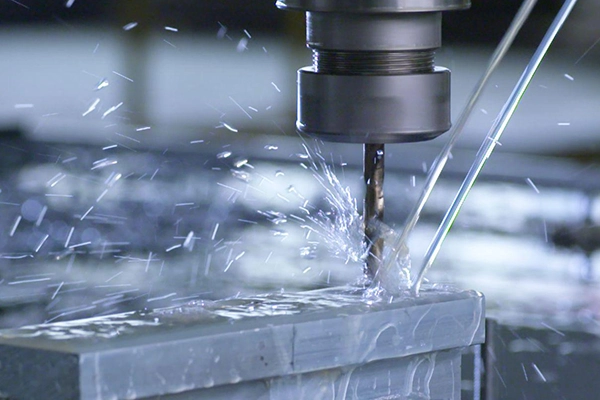
Stainless steel does not break chips. It produces long, stringy ribbons that wrap around tool holders, scratch finished diameters, and stop automated bar feeders. For any stainless steel machining services provider, chip breaking is the #1 productivity challenge.
Our proven recipe for chip control on 304/316:
Insert geometry: Chip breaker with a tight radius (MF or MM class)
Feed rate: Minimum 0.12 mm/rev – below that, chips will not break
Depth of cut: At least 1.5x the nose radius (e.g., 0.6mm for a 0.4mm radius insert)
Coolant: 10% semi-synthetic at 300 PSI, directed exactly at the cut zone
If your supplier’s chip bin contains birds’ nests (long tangled coils) instead of small 6-shaped or C-shaped chips, they do not understand stainless steel machining services. Walk away.
Surface Finish Requirements for custom stainless steel parts in Motion
Automation components see sliding contact. A rough turned surface (Ra > 1.6µm) will wear out linear bearings, increase friction, and generate heat. For custom stainless steel parts that guide, rotate, or seal, specify:
Ra ≤ 0.8µm for shaft surfaces that contact bearings (achievable with wiper inserts)
Ra ≤ 0.4µm for seal contact areas (requires finish grinding or polishing)
No directional lay for seal faces (use a non-rotary finishing pass or plunge grind)
We hit 0.6µm Ra on 17-4 PH shafts using a CBN wiper insert at 120 m/min surface speed. That is ground finish quality without a grinder. For steel turned parts with critical sealing requirements, we add a micro-finishing step using a diamond film.
Procurement Logic: Single-Source vs. Dual-Source for Steel Components
Here is the purchasing decision framework I share with my own customers. When you buy steel turned parts and custom laser cut steel brackets from two different vendors, you pay hidden costs:
Cost Category
Two Vendors
One Integrated Shop
Setup fees
2x (turning + fab)
1x (combined setup)
Shipping
Two LTL shipments
One consolidated LTL
Inspection
Two reports, two datums
Single CMM report, one datum
Fit-up liability
Split – “not our part”
One accountable party
Lead time coordination
Critical path longest
Overlapped operations
For any assembly with more than three mated features between turned and fabricated components, the integrated shop wins on total landed cost – even if their per-part price looks 8-12% higher. I have run this math on over 200 RFQs.
Thread Rolling vs. Thread Cutting for steel turned parts
Cut threads in stainless steel are weak because the cutter shears the grain structure. Rolled threads compress the material, increasing fatigue strength by 30-50%. For any steel turned parts that will see vibration, cyclic loading, or torque (automation arms, hydraulic fittings, motor shafts), specify rolled threads.
Limitation: Thread rolling requires a minimum diameter of 3mm and a lead-in chamfer of at least 45 degrees. For very small threads (M2 or smaller), rolling is impossible – we use thread whirling on our Swiss lathes.
Thread Size
Recommended Process
Fatigue Life Improvement
M2 – M2.5
Cut (whirling)
1x baseline
M3 – M12
Rolled
1.5x baseline
M14 – M30
Rolled (or cut for low volume)
1.4x baseline
For custom stainless steel parts with rolled threads, always specify the thread class before rolling (typically 6g for external threads). The rolling dies will adjust the pitch diameter correctly.
Welding Considerations for custom stainless steel fabrication
If your custom stainless steel fabrication includes welded brackets that hold steel turned parts, pay close attention to heat input and sequence. Excessive welding warps the bracket, pulling your turned shaft out of alignment. We use:
TIG welding with back-purge (argon) for sections under 3mm thick
Tack welding first at four points, then full weld in alternating sequence (skip weld)
Post-weld stress relief at 400°C for 1 hour for 304/316 (air cool)
Skipping stress relief on a welded automation frame that holds steel turned parts with 0.02mm tolerances guarantees field failure within 10,000 cycles. We have seen it happen. Do not be that buyer.
Why In House stainless steel cnc machining services Beat Brokering
I have audited shops that claim to offer stainless steel cnc machining services but actually outsource all turning to a low-cost provider. The parts arrive with:
Inconsistent chamfers (tool wear not tracked)
Scratched OD from poor part handling between operations
Threads that fail go/no-go gauges (rolled threads outsourced to a different sub-vendor)
When you choose a supplier that owns their stainless steel cnc machining services in-house, you get real-time SPC, tool life tracking, and immediate corrective action. We run a Zeiss DuraMax CMM on every lot of steel turned parts with tolerances ≤0.01mm. Every lot. Not every 50th part.
Ask your vendor: “Do you control your own machining, or do you broker it?” The answer determines your risk.
PAA (People Also Ask) – Practical Answers from the Shop Floor
Q1: What is the maximum hardness for turning steel on a standard CNC lathe? You can turn steel up to 45 HRC with standard carbide inserts (grade 1105 or similar). Above 45 HRC, you need CBN (cubic boron nitride) or ceramic inserts, and speeds drop below 80 m/min. For parts harder than 55 HRC, switch to grinding or wire EDM. I always advise designing custom turned parts for machining in the annealed condition, then heat treating to final hardness.
Q2: How do you prevent work hardening when machining 304 stainless? Use a feed rate of at least 0.10 mm/rev and never let the tool rub. If your insert dwells on the surface, the steel hardens instantly to 40+ HRC. Also, take a depth of cut deeper than the previous pass’s work-hardened layer – typically 0.5mm minimum. For steel cnc machining of 304, aggressive cutting is safer than light passes. Light passes = rubbing = work hardening = broken inserts.
Q3: Can you laser cut stainless steel up to 12mm thick? Yes, a 4kW fiber laser will cut 12mm 304 stainless cleanly, but edge squareness drops. For custom laser cut steel thicker than 10mm, specify plasma or waterjet if you need a truly square edge (0.1mm taper per side is typical for laser). We use laser for all sheet under 8mm and waterjet for thicker plates. Always ask for edge samples before committing to high volumes.
Q4: What is the typical lead time for stainless steel fabrication services including turned parts? For a mixed order of 500 turned shafts (17-4 PH) and 100 laser-cut 304 brackets, expect 3-4 weeks. Turning takes 5-7 days (depending on complexity), heat treat adds 2-3 days, fabrication takes 5 days, and passivation adds 2 days. We overlap operations to ship in 15-18 days. Expedite (10 days or less) costs +30% and requires dedicated machine time.
Ready to Quote Your Next steel turned parts Project?
You have seen the eight rules – alloy selection, heat treat sequencing, realistic tolerances, fabrication integration, chip control, surface finish, procurement logic, thread rolling, welding, and in-house CNC. Now it is time to work with a shop that applies every single rule to your custom stainless steel parts and custom laser cut steel components.
We are machinists who weld and fabricators who turn – all under one roof. Send us your STEP file and PDF drawing. We will reply within 24 hours with:
A complete DFM analysis (specific callouts that cannot be made as drawn)
Per-part pricing for volumes from 100 to 50,000 pieces
Lead time options with and without heat treatment
Upload your drawings below for a same-day engineering review and firm quote.
Ready to start
Your next project?
Contact our technical experts today for a customized solution and a tailored quotation.
Our expert team will contact you within 24 hours
to provide a free technical evaluation and solution design, helping you upgrade your production process.
ADDRESS
NO.22,You Yi Road ,Wulian Community, LongCheng Street ,Long gang District ,Shen Zhen