Master Aluminum CNC Services: The Engineer’s Blueprint for Zero-Defect Precision Parts
Aluminum is the most commonly machined metal in precision manufacturing. Yet nearly 30% of aluminum CNC machined parts require rework due to poor surface finish, tolerance drift, or tooling-related defects. The material’s high thermal conductivity and low melting point make it uniquely challenging—cutting edges weld, chips stick, and thermal expansion alters dimensions mid-cycle.
This guide equips product engineers, mechanical designers, and procurement specialists with the technical framework to specify aluminum CNC services that deliver consistent, high-quality results. We cover alloy metallurgy, cutting parameter optimization, tolerance strategies, and surface finishing—all backed by real production data from thousands of CNC aluminum jobs across automotive, medical, and aerospace sectors.
Aluminum Alloy Selection—The Foundation of Successful CNC Aluminum Machining
The alloy you specify determines everything: machinability, tool life, dimensional stability, and final part performance. Each series behaves differently under the cutting tool. Yueyi Precision’s aluminum CNC services routinely process all major alloy families, and our engineering team provides free DFM feedback to match the right alloy to your functional needs—explore our dedicated professinal aluminum CNC machining page for alloy-specific machinability data.
6000 Series – The Versatile Workhorse (6061, 6063)
6061-T6 is the most common alloy for aluminum CNC services. It offers excellent machinability, good corrosion resistance, and moderate strength (UTS: 310 MPa). Chip formation is clean, cutting forces are low, and surface finishes of Ra ≤ 1.6μm are achievable without extensive post-processing.
6063 prioritizes surface finish and formability over strength, making it ideal for architectural and cosmetic components.
7000 Series – High-Strength Precision
7075-T6 delivers ultra-high strength (UTS: 572 MPa)—stronger than many steels while remaining lightweight. It machines with higher hardness than 6000 series, requiring carbide or PCD tooling. The payoff is superior cutting precision for complex geometries and excellent resistance to deformation during heavy machining.
2000 Series – Aerospace Fatigue Resistance
2024-T351 offers high strength (UTS: 470–485 MPa) and exceptional fatigue resistance. It’s the go-to for aircraft structural parts and high-stress mechanical components. Machinability is good in annealed states, though harder tempers demand robust tooling.
5000 Series – Corrosion-Resistant
These magnesium-rich alloys are soft and ductile, ideal for forming and bending without cracking. They deliver excellent surface finish for marine, automotive, and corrosion-sensitive applications.
Table 1: Aluminum Alloy Comparison for CNC Aluminum Services
Alloy
UTS (MPa)
Machinability
Key Applications
Tooling Recommendation
6061-T6
310
Excellent
Aerospace brackets, automotive parts, robotics
Carbide, 2–3 flute
7075-T6
572
Good (harder)
Aircraft structures, motorsport, precision molds
Carbide or PCD
2024-T351
470–485
Good
Wing spars, landing gear, high-stress components
Carbide, robust tooling
5052
Moderate
Very good
Marine parts, decorative components, sheet metal
Carbide, sharp edges
Source: Production data from Yueyi Precision’s aluminum CNC services across 17+ years of global OEM supply.
Cutting Parameters That Define High-Quality Aluminum CNC Services
Cutting parameters directly impact surface finish, tool life, and dimensional accuracy. For aluminum CNC services, getting these numbers right separates production-grade parts from scrap. Our in-house process database, refined over decades, provides the baseline for every job—review our full CNC machining capabilities to understand how we apply these parameters across multi-axis machines.
Cutting Speed (Surface Speed)
Aluminum allows significantly higher cutting speeds than steel or stainless. For CNC aluminum milling:
These values assume carbide tooling with proper coolant application. For high-speed machining centers (15,000–20,000 RPM spindle), these speeds translate to exceptional material removal rates while minimizing heat input.
Feed Rate and Chip Load
Chip load (feed per tooth) determines chip thickness and heat generation. For aluminum machining with carbide end mills:
1/8″ diameter: 0.001 IPT (inches per tooth)
1/4″ diameter: 0.002 IPT
1/2″ diameter: 0.004 IPT
3/4″ diameter: 0.006 IPT
Aluminum produces long, stringy chips that must be evacuated efficiently. Insufficient chip clearance leads to recutting, heat buildup, and tool welding.
Table 2: Recommended Cutting Parameters for Common Aluminum Alloys
Tolerance Control in Precision Aluminum CNC Services
Tolerance specification is where engineering intent meets manufacturing reality. Over-specifying tolerances inflates costs disproportionately; under-specifying risks assembly failure. For production scalability, ourprototype to production framework ensures that tolerance strategies developed during prototyping remain stable through high-volume runs—without compromising lead times.
Precision Tolerance Capability
For demanding applications, aluminum CNC services can achieve significantly tighter tolerances:
Standard machining tolerance: ±0.025 mm
High-precision features: ±0.005 mm (available on request)
Our CNC machining centers consistently hold ±0.005mm on critical aluminum features. This level of precision requires:
Temperature-controlled production environment
CMM inspection verification
Rigorous in-process SPC monitoring
Tolerance vs. Cost—The Engineer‘s Trade-off
Tolerance Class
Typical Range
Cost Impact
Inspection Method
General (ISO 2768-m)
±0.10 mm
Baseline
Calipers, height gauges
Precision
±0.02–0.05 mm
+20–40%
CMM, specialized gauging
High-Precision
±0.005–0.01 mm
+50–100%
Full CMM, temperature-controlled
Tightening a tolerance beyond functional need wastes time and money. Specify tight tolerances only on features that directly affect assembly, fit, or performance.
Surface Finish Options for CNC Aluminum Parts
Surface finish affects aesthetics, corrosion resistance, and functional performance. Aluminum CNC services offer multiple surface finish pathways. For detailed milling strategies that influence surface quality, refer to our milling aluminum guide—it covers toolpath optimization and cutter selection in depth.
As-Machined Finish
Modern CNC aluminum machining with optimized parameters achieves as-machined surface finishes of Ra ≤ 1.6μm. High-speed milling (15,000–20,000 RPM) with sharp carbide tooling often eliminates the need for secondary polishing.
Bead Blasting
Bead blasting produces a uniform matte finish that masks machining marks. It’s commonly specified for cosmetic aluminum parts and as a surface preparation for anodizing.
Anodizing (Type II and Type III)
Anodizing enhances corrosion resistance and provides decorative color options:
Type II (Standard Anodizing): Coating thickness 8–12μm, provides reasonable wear and corrosion resistance with broad color flexibility
Type III (Hard Anodizing): Coating thickness 35–50μm, offers superior wear and corrosion resistance for demanding applications
Table 3: Surface Finish Options for Aluminum CNC Services
Finish Type
Typical Ra
Application
Cost Impact
As-Machined
0.8–1.6 μm
Functional surfaces, cost-sensitive
Baseline
Bead Blasted
1.6–3.2 μm
Cosmetic, pre-anodize prep
Low
Type II Anodize
N/A
Decorative, corrosion protection
Moderate
Type III Hard Anodize
N/A
High-wear, aerospace, defense
High
Tooling Strategies That Maximize CNC Aluminum Service Quality
Tool selection is the single most critical variable in CNC aluminum success. The wrong tool welds, breaks, or produces scrap.
Flute Count—The Chip Evacuation Decision
Aluminum produces long, stringy chips. Fewer flutes means more chip space:
2-flute end mills: Maximum chip evacuation, ideal for slotting and roughing
3-flute end mills: Balanced approach for general-purpose aluminum machining
Higher flute counts: Risk chip packing and tool welding—avoid for most aluminum applications
Helix Angle and Edge Preparation
Carbide end mills designed for aluminum typically have a high helix angle (45° or higher) for efficient chip evacuation and reduced recutting risk. Sharp edges with polished or low-friction flutes minimize aluminum adhesion and built-up edge (BUE).
Coolant Strategy
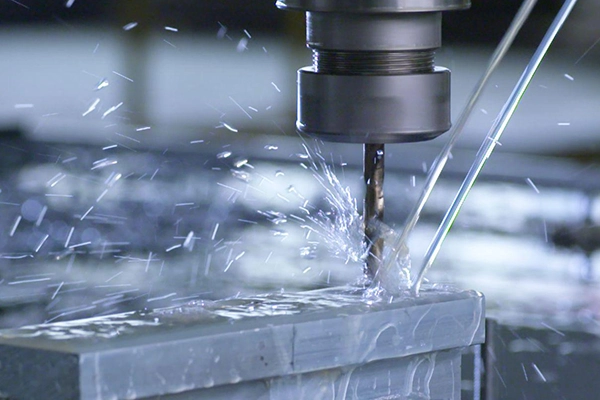
Aluminum‘s high thermal conductivity means heat transfers quickly to the tool. Proper coolant application is non-negotiable for CNC aluminum operations. Through-spindle coolant and high-pressure flood systems deliver the best results for deep pockets and thin-wall features.
Common Failure Modes in Aluminum CNC Services—and How to Prevent Them
Temperature control, rigid fixturing, in-process inspection
Chip Welding
Insufficient chip evacuation
2–3 flute tools, high-pressure coolant
Thin-Wall Deformation
Excessive cutting forces
Reduced depth of cut, adaptive toolpaths
Source: Production engineering data from Yueyi Precision’s aluminum CNC services
PAA (People Also Ask)
Q: What is the best aluminum alloy for CNC machining? A: 6061-T6 is the most commonly specified alloy for aluminum CNC services due to its excellent machinability, good strength (UTS: 310 MPa), and corrosion resistance. For high-strength applications requiring superior mechanical properties, 7075-T6 delivers ultra-high strength (UTS: 572 MPa) but requires carbide or PCD tooling.
Q: What tolerance can aluminum CNC machining achieve? A: Standard aluminum CNC services achieve ±0.025 mm for general features. High-precision CNC machining can hold ±0.005 mm on critical features with CMM inspection and temperature-controlled production.
Q: What surface finish is achievable with CNC aluminum machining? A: As-machined surface finishes of Ra 0.8–1.6 μm are standard. For finer finishes, secondary processes like bead blasting or anodizing can be specified. Type II anodizing adds 8–12μm coating thickness; Type III hard anodizing adds 35–50μm for wear-resistant applications.
Q: How does aluminum compare to steel for CNC machining? A: Aluminum allows significantly higher cutting speeds (1,200 m/min for 6061 vs. ~200–400 m/min for steel), lower cutting forces, and generally tighter tolerances due to reduced distortion risk. However, aluminum‘s soft, “gummy” nature requires careful tool selection to prevent built-up edge and chip welding.
Q: What industries use CNC aluminum machined parts? A: CNC aluminum parts are widely used in automotive, aerospace, medical devices, robotics, semiconductor equipment, and consumer electronics. Common applications include electronic enclosures, industrial brackets, mechanical assemblies, aircraft structures, and precision molds.
Engineering Partnership for Precision Aluminum CNC Services
Delivering reliable aluminum CNC services requires more than advanced equipment—it demands experienced engineering oversight, controlled processes, and accurate measurement systems. Yueyi Precision operates 100+ CNC machining centers across a 5,000+ m² ISO 9001:2015 and IATF 16949 certified facility.
Our engineering team supports every project with:
DFM optimization for manufacturability and cost efficiency
In-process SPC monitoring for dimensional stability across production batches
Full traceability with mill test certificates for every material batch
CMM inspection for GD&T compliance and dimensional verification
For prototypes, our aluminum CNC services deliver functional parts in 3–5 days. For production runs, we scale from 1-piece prototypes to 100,000+ pieces with consistent quality.
Ready to start
Your next project?
Contact our technical experts today for a customized solution and a tailored quotation.
Our expert team will contact you within 24 hours
to provide a free technical evaluation and solution design, helping you upgrade your production process.
ADDRESS
NO.22,You Yi Road ,Wulian Community, LongCheng Street ,Long gang District ,Shen Zhen