Aluminum Extrusion vs CNC Machining: How Engineers Choose by Geometry, Volume, Cost, and Tolerance
Choosing between aluminum extrusion vs CNC machining is not simply a contest between a cheaper process and a more accurate one. The correct route depends first on geometry, then on production volume, tooling commitment, tolerance ownership, alloy condition, and design maturity. Extrusion is efficient when a part is built around a continuous cross-section. CNC machining is more flexible when geometry changes in three dimensions or the design is still evolving. Many industrial components achieve the best total result by combining both: extrusion creates the material-efficient base profile, while CNC machining adds holes, threads, datum faces, pockets, and controlled interfaces. This guide gives engineers and overseas buyers a practical framework for selecting the process around the part rather than around a supplier’s preferred machine.
The Short Answer: Which Manufacturing Route Fits Your Part?
The fastest way to evaluate aluminum extrusion vs CNC machining is to separate the part into two questions: how much of its geometry repeats along one direction, and which features directly control assembly performance? The answers usually point toward extrusion, machining from solid stock, or a hybrid route.
Choose extrusion when the cross-section creates most of the part.
Extrusion is a strong candidate when ribs, fins, channels, screw bosses, enclosed voids, and external walls continue along the length of the component. A die can form these features together, reducing the amount of metal that must later be removed. The economics improve after the design is stable and forecast demand is sufficient to justify dedicated tooling, trial runs, and minimum production quantities.
Extrusion is especially suitable when:
The principal cross-section remains constant.
Longitudinal cavities or fins would be wasteful to machine from billet.
Most profile dimensions can use appropriate extrusion tolerances.
Cutting, drilling, or end machining can complete the component.
The program can absorb die development and material commitments.
Choose CNC machining when the part is defined by three-dimensional features.
CNC machining is normally more suitable for prototypes, lower volumes, frequent design revisions, and parts containing localized geometry on several faces. Pockets, angled holes, precision bores, sealing lands, compound surfaces, and discontinuous contours are created by programmed toolpaths rather than a fixed die opening.
In the extrusion vs machining decision, CNC also reduces initial tooling commitment. A design change may require a revised program or fixture, but it does not automatically require a new extrusion die. That flexibility is valuable during product verification, when mounting positions and functional interfaces are still changing.
Choose a hybrid route when the base shape repeats but its interfaces need precision.
The most effective answer is often extrusion plus CNC machining. The die produces a near-net profile, and machining is reserved for features that need localized accuracy or cannot run continuously along the profile.
Part Condition
Recommended Route
Engineering Reason
Constant cross-section with simple length and hole requirements
Extrusion
The die forms most of the geometry efficiently
Complex three-dimensional geometry at low volume
CNC machining
No custom extrusion die is required
Constant body with holes, threads, and datum faces
Extrusion plus CNC
Each process controls the features it produces best
Design still changes after prototype testing
CNC first
Tooling risk remains low during revision
Stable design with repeat demand
Reassess extrusion
Tooling can be evaluated against recurring savings
How Part Geometry Determines Extrusion, CNC Machining, or a Hybrid Route
A sound aluminum extrusion vs CNC machining comparison starts with different manufacturing principles. Extrusion forms heated metal through a shaped opening, while CNC machining removes material through controlled cutting operations. Understanding this distinction prevents buyers from comparing quotations only by unit price.
Continuous Cross-Sections and Features That Belong in the Extrusion Die
An aluminum billet is heated and pushed through a die that defines the cross-section. The emerging profile is cooled, stretched or straightened as required, aged to the specified condition, and cut to manageable lengths. Solid, hollow, and semi-hollow profiles require different die structures and introduce different flow-control challenges.
Good extrusion design balances wall thickness, symmetry, corner radii, tongue stability, and metal flow. A feature that appears simple in CAD may create uneven flow or weak die sections, so early DFM review is essential.
For components built around a repeatable cross-section, Yueyi provides custom aluminum extrusion manufacturing from profile review and die coordination through cutting and secondary processing.
Localized Features That Require CNC Machining
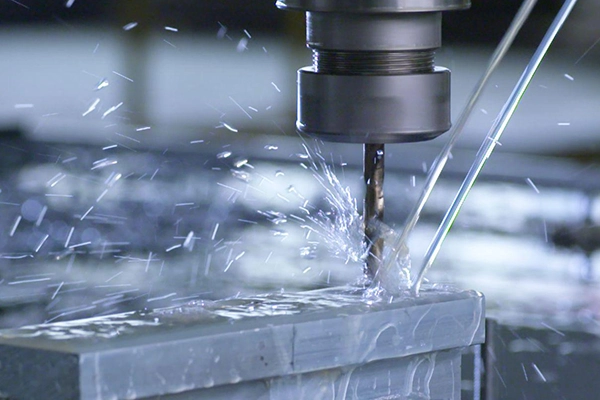
CNC milling, turning, drilling, boring, and tapping remove material from plate, bar, billet, casting, forging, or extrusion. This gives the process freedom to create geometry that changes from face to face. It also means cost is influenced by material removal, setup count, tool reach, fixture rigidity, cycle time, and inspection effort.
When evaluating CNC machining vs extrusion, machining provides greater revision flexibility and local dimensional control, while extrusion can reduce the amount of material and machine time needed to establish the basic shape.
In aluminum extrusion vs CNC machining, volume matters only after the geometry is manufacturable. High annual demand cannot make a fully three-dimensional part suitable for extrusion, while low initial volume does not eliminate an extrusion-ready design for later production.
Features that extend along the extrusion direction can often be incorporated into the profile:
Heat-dissipation fins
Longitudinal stiffening ribs
Wiring or cable channels
Screw bosses and assembly grooves
Internal voids for weight reduction
Alignment rails and locating features
Outer walls for equipment enclosures
The key is continuity. If a pocket stops halfway along the component, a hole crosses the profile, or an interface changes height locally, that feature will normally require another operation.
CNC machining becomes more important when the part needs bearing seats, gasket surfaces, intersecting holes, counterbores, threads, sensor interfaces, or accurately related mounting faces. These features are defined by their position relative to a datum system, not merely by the cross-section.
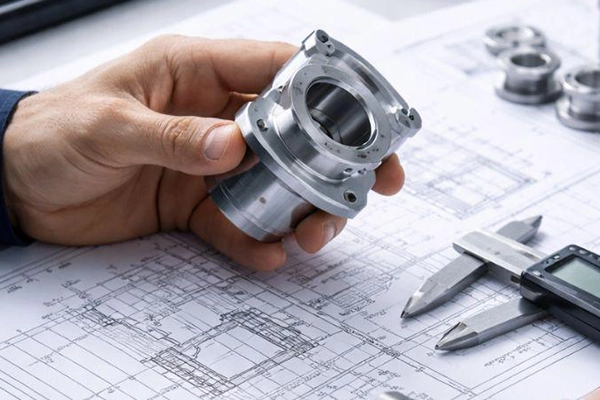
The comparison of extruded aluminum vs machined aluminum should therefore focus on the final functional geometry. An extruded profile can still become a precision machined part after datum surfaces and interfaces are finished.
Use the following sequence before requesting prices:
Can most of the component be represented by one cross-section?
Which features continue along the extrusion direction?
Which features are local, angled, threaded, or datum-controlled?
Can the profile include machining allowance around those features?
Will machining release stress or distort a thin, open section?
Can the part be supported without crushing or twisting the profile?
Is the design stable enough to release dedicated tooling?
If the answers reveal a continuous base shape and limited local features, aluminum extrusion vs CNC machining is not an either-or decision. It becomes a process-allocation exercise.
Comparing Tooling Cost, Unit Cost, and the Real Volume Breakpoint
In aluminum extrusion vs CNC machining, buyers often ask when extrusion becomes cheaper. There is no universal answer. Tooling complexity, profile weight, material yield, CNC cycle time, finishing, inspection, minimum commitments, and design life affect the breakpoint.
Comparing Tooling Investment, Material Yield, and Recurring Unit Cost
Machining generally avoids a dedicated extrusion die, making it attractive for development and low-volume purchasing. However, aluminum extrusion vs billet machining becomes decisive when the starting block contains much more aluminum than the finished part.
CNC Cost Element
Primary Driver
Programming
Number of operations and geometric complexity
Workholding
Setup count, access, and repeatability
Cycle time
Material removal and finishing passes
Cutting tools
Reach, wear, diameter, and surface requirements
Inspection
GD&T, critical features, and reporting scope
Raw material
Stock size, alloy, and usable yield
Yueyi’s precision CNC machining services support prototypes and production parts requiring controlled features on multiple faces.
The extrusion quotation may include die engineering, trial material, correction loops, production setup, minimum billet or lot requirements, heat treatment, straightening, cutting, and packaging. The finished-part price must also include any aluminum extrusion post machining, surface treatment, inspection, and rejected material—not only the price per kilogram of the raw profile.
The most useful view of aluminum extrusion cost separates non-recurring and recurring elements:
Risk-related: die revision, minimum order exposure, forecast changes, and obsolete stock.
Calculating the Real Break-Even Point from Supplier Quotations
The calculation is only valid when both routes produce equivalent parts and the CNC unit cost exceeds the extrusion-based unit cost. The tooling investment should include the complete extrusion die cost, trial and correction charges, dedicated gauges, and fixtures. The extrusion-based unit cost must include secondary machining and finishing.
For aluminum extrusion vs CNC machining, buyers should also calculate cash tied up in minimum material purchases. A theoretically lower piece price may not improve the program if demand is uncertain or the design will soon change.
Tolerances, Datums, and Material Condition Must Be Evaluated Together
In aluminum extrusion vs CNC machining, the processes should not receive the same dimensional responsibilities. Extrusion controls the continuous profile; machining controls selected functional interfaces. Clear ownership prevents unnecessary die corrections and avoids machining nonfunctional surfaces.
Assigning Tolerance Ownership Between the Extrusion and CNC Operations
Feature
Extrusion Responsibility
CNC Responsibility
General profile wall and rib
Primary
Only if locally critical
Longitudinal internal channel
Primary
Only if rework is specified
Bearing or precision locating bore
No
Primary
Threaded or cross-drilled hole
No
Primary
Sealing or precision mounting face
Usually not final
Primary
General cut length
Sawing may be sufficient
Use CNC if tightly controlled
Cosmetic external surface
Extrusion and finish route
Machine only when specified
Applying tight aluminum extrusion tolerances to every wall, groove, and external surface can increase tool correction, inspection, sorting, and rejection without improving assembly. A better drawing identifies which profile dimensions are functionally necessary and leaves machining allowance where tighter local control is required.
Specifying tight CNC machining tolerances does not guarantee a functional result if the datum strategy is poor. A machined hole may meet its diameter requirement but still be misplaced relative to a mounting face. Drawings should define the interfaces that control assembly and use tolerances appropriate to the mating components.
This is a major distinction in aluminum extrusion vs CNC machining: extrusion variation may affect the condition of the incoming blank, while CNC accuracy depends on how that blank is located, supported, and measured.
During machining aluminum extrusions, the fixture must accommodate reasonable profile variation without forcing the part into an artificial shape. Overclamping a thin wall can make a feature appear correct in the machine and move after release.
Practical controls include:
Locating from stable surfaces connected to the functional datum.
Using contoured soft jaws to distribute clamping pressure.
Supporting long spans to control vibration.
Using internal supports for hollow or thin-walled profiles when appropriate.
Separating roughing and finishing when material removal may release stress.
Inspecting the part in a free or drawing-defined restrained condition.
How Alloy, Temper, Residual Stress, and Clamping Affect Accuracy
An aluminum extrusion vs CNC machining decision cannot ignore alloy and temper. Extrudability, machinability, strength, corrosion behavior, anodizing response, and dimensional stability vary with material condition.
Decision Area
6061-Oriented Choice
6063-Oriented Choice
Typical priority
Structural performance and machining balance
Extrudability and surface appearance
Common route
Machined parts or structural profiles
Complex profiles and visible surfaces
Machining concern
Toolpath, burrs, and released stress
Softer cutting behavior and edge quality
Finishing concern
Functional anodizing and protection
Consistent cosmetic anodizing
This table is a starting point, not a substitute for drawing requirements. Strength level, temper, profile complexity, finishing class, and availability must be reviewed together.
The phrase extruded aluminum vs machined aluminum can be misleading because a machined component may begin as extruded stock. It may also begin as plate, bar, casting, or forging. A valid comparison should state four items:
Alloy
Temper or material condition
Starting form
Final manufacturing and finishing route
For example, two parts described as 6061 can behave differently if one is machined from plate and the other is cut from a thin-walled extrusion. Procurement documents should therefore define the approved starting form when it affects strength, appearance, traceability, or dimensional stability.
Buyers who need local precision after profile formation can review Yueyi’s aluminum CNC machining for precision features when planning alloys, datum surfaces, holes, threads, and final inspection.
Engineering the Extrusion-to-CNC Workflow for Repeatable Production
Within aluminum extrusion vs CNC machining, hybrid manufacturing assigns material formation to extrusion and local accuracy to machining. It is most valuable when much of a billet would otherwise become chips but the component still needs controlled interfaces.
From Profile DFM and Die Trial to CNC Fixture Qualification
The die can establish walls, hollow sections, fins, ribs, rails, and longitudinal mounting features. Effective profile design places material where the component needs stiffness, thermal area, fastener support, or enclosure volume. It also avoids sharp transitions and severe wall imbalance that make flow control difficult.
Aluminum extrusion machining can add:
Cut lengths with controlled end relationships
Cross-holes and tapped holes
Local pockets and connector openings
Precision faces and sealing lands
Bearing or locating bores
Slots that stop before the end of the component
Datum features for downstream assembly
The aim is not to machine every visible surface. It is to control the features that carry functional requirements while retaining the material and cycle-time benefits of the profile.
Preventing Distortion, Datum Drift, Chatter, and Surface Variation
In this hybrid context, aluminum extrusion vs CNC machining becomes the wrong question if it implies only one process can be used. The better question is which process should create each feature.
Decision Scenarios for Automotive, Electronics, LED, and Medical Equipment
The selection framework applies differently by industry. The following examples focus on Yueyi Precision’s relevant B2B markets and exclude doors, windows, general construction, 3D printing, and aerospace applications.
Application
Geometry Pattern
Recommended Route
CNC-Controlled Features
Main Purchasing Risk
Automotive structural or thermal rail
Continuous section with repeated mounting areas
Extrusion plus CNC
Sensor faces, holes, joining interfaces
Straightness and accumulated hole position
Electronics or industrial enclosure
Continuous shell with local openings
Extrusion plus CNC
Ports, threads, windows, mating faces
Cosmetic and dimensional consistency
Early enclosure prototype
Geometry is still changing
CNC machining
Complete provisional geometry
Premature die investment
LED stage frame or display support
Long structural section with assembly interfaces
Extrusion plus CNC
Locks, cutouts, holes, assembly datums
Long-part fixture repeatability
Medical or diagnostic equipment support
Localized precision around a structural body
CNC or hybrid
Sensor, cover, and mechanism interfaces
Traceability and inspection documentation
Automotive parts must be reviewed against load paths, joining methods, corrosion exposure, and production traceability. Electronics enclosures place additional emphasis on cosmetic surfaces and connector alignment. LED structures often introduce cumulative hole-position and assembly-fit risks over long lengths. For non-implantable medical equipment, material traceability, cleanable surfaces, and inspection documentation should be established in the RFQ. These examples deliberately exclude doors, windows, general construction, 3D printing, and aerospace applications from Yueyi’s target content strategy.
A Procurement Framework for Selecting and Quoting the Right Process
The following matrix converts the engineering discussion into a sourcing decision. It should be completed with actual supplier quotations and drawing requirements rather than treated as a fixed ranking.
Decision Factor
Extrusion
CNC Machining
Extrusion Plus CNC
Primary geometry
Constant cross-section
Freely varying 3D form
Constant body with local features
Prototype flexibility
Lower
High
Medium
Upfront tooling
Custom die
Usually limited
Die plus machining fixtures
Recurring material use
Efficient near-net profile
Depends on billet-to-part ratio
Usually efficient
Tight local interfaces
Limited without secondary work
Strong
Strong
Long internal voids
Strong
Material-intensive or impractical
Strong
Design revisions
May require die changes
Program or fixture change
Depends on affected geometry
Best purchasing stage
Stable production design
Prototype and complex low volume
Stable profile with precision features
For a new program, evaluate aluminum extrusion vs CNC machining at prototype release and again after design validation. The best route may change when geometry stabilizes and reliable demand data becomes available.
Complete RFQ data allows suppliers to compare equivalent manufacturing routes. Without controlled drawings, forecast quantities, and functional requirements, quotations may use different assumptions and appear comparable when they are not.
Provide:
A STEP model and revision-controlled 2D drawing
Alloy, temper, and permitted starting forms
Prototype, batch, and annual demand
Critical dimensions, GD&T, and datum definitions
Required straightness, flatness, and twist limits
Surface finish, anodizing, coating, or cosmetic class
Mating-part and assembly information
Inspection reports and material certification requirements
Packaging length and protected-surface requirements
Expected program life and forecast stability
Confirmation of whether the design is frozen
Also request separate visibility for tooling, raw profile, secondary machining, finishing, inspection, and logistics. That breakdown makes the extrusion vs machining comparison more meaningful and exposes costs that may otherwise appear later.
Final recommendation: Use extrusion when a stable, continuous cross-section creates most of the component and forecast demand can justify tooling. Use CNC machining when the part is three-dimensional, requires frequent revisions, or needs precision across multiple localized features. Use the hybrid route when extrusion can create a material-efficient body and machining can finish only the interfaces that govern assembly. The correct evaluation of aluminum extrusion vs CNC machining must consider the controlled CAD model, alloy and temper, starting form, batch volume, annual demand, tolerance ownership, surface requirements, inspection scope, and inventory exposure. Yueyi Precision supports both manufacturing hubs, allowing its engineering team to assess the part without forcing it into a single process. Submit your model and drawing for a DFM review and route comparison.
Ready to start
Your next project?
Contact our technical experts today for a customized solution and a tailored quotation.
Our expert team will contact you within 24 hours
to provide a free technical evaluation and solution design, helping you upgrade your production process.
ADDRESS
NO.22,You Yi Road ,Wulian Community, LongCheng Street ,Long gang District ,Shen Zhen